Vibe Marketing: A Fad or the Future?
Vibe marketing is about selling vibes instead of products or services. In this era of saturated markets and increasing competition, modern customers care less about brand legacy or quality but more about how the brand makes them feel. Yes, it uses AI sometimes – but is that all? Or is there more to it? Is it just a fad or the future?
What is Vibe Marketing?
Vibe marketing is a marketing strategy centered on building an emotional character around a brand – basically selling vibes instead of specific products. You market to people’s feelings instead of just needs and wants. This positions your brand as the new “cool guy” in town – someone everybody would like to hang out with.
Vibe Marketing Origin Story
The term vibe marketing comes from “vibe coding” – something coined by Andrej Karpathy (Co-founder of OpenAI) to denote a modern programming trend where developers use AI and prompts using naturalistic language to code and build. Like vibe coding, vibe marketing appeals to people’s feelings over anything else.
Who Needs it and Why?
Vibe marketing is one of the most convenient marketing strategies for fresh startups and small businesses. These types of brands and businesses can leverage AI to quickly benefit while using less resources and finances to cut through the noise and incorporate all the various market insights into cohesive and emotionally resonant brand campaigns.
The following are some of the key benefits of vibe marketing for startups:
- Allows them to function as a well-oiled, productive organisation without any corporate or inter-departmental red tape.
- AI can screen markets and competitors for a never-ending stream of relevant blog ideas and posts.
- Measure and screen marketing results in real time by having an AI monitor the market and impact of brand campaigns in real-time.
- AI can streamline target marketing, which at once attracts new customers and retains old ones.
- Vibe marketing can help organically develop brand fanbases with community engagement forums and activities.
Vibe Marketing Playbook
The following are some of the key things to keep in mind if you’re thinking of using the vibe marketing strategy for your brand.
Vibe Marketing Channels
Vibe marketing cannot be deployed across all channels – that’ll result in a try-hard brand image, and people are only turned off by that. The following are some popular marketing channels where vibe marketing performs best:
- Reel Platforms (YouTube Shorts, Instagram, TikTok etc.)
- Community Spaces (Brand Forums, Discord, Reddit etc.)
- IRL Experiences (Offline Stores, IRL Activation Campaigns, etc.)
The Pitfalls of Vibe Marketing
A marketing strategy that heavily integrates AI into the process is sure to have its own downsides and ethical concerns, which must be addressed head-on. The pitfalls of vibe marketing can be broadly categorized under the following:
Ethical Concerns
When AI reads market data, makes statistics and forms algorithms to generate emotionally charged targeted experiences, it can often feel like manipulation instead of persuasion.
Authenticity Concerns
The authenticity of brands using vibe marketing can be questioned – and their marketing can also suffer from superficially emotional campaigns.
Security & Compliance Issues
AI can read, manipulate and use private data to breach security and privacy laws – leading to serious legal consequences.
Identity Burnout
A brand that’s constantly trying to keep up with the times, using vibe marketing, will also quickly reach a burnout stage where an identity loss is imminent.
Over-use of AI Automation
Over-automation can remove the human element from the marketing campaigns. Vibe marketing, though it integrates AI heavily, must always remain human-led.
AI Hallucination
AI can hallucinate and forge false data – this can lead to dangerous consequences in terms of messaging and measuring ROIs and KPIs.
Generic Content
AI reads the markets and trends and returns the mean average as results – this can often lead to generic ideas and content, which must be actively checked and prevented.
The Problem of Exception Cases
Since AI studies the mean average of all information, exceptional cases are often overlooked, which ruins customer experience and often reveals hidden loopholes others can exploit.
At the end of the day, over-reliance on AI and using only one marketing strategy as a crutch will spell downfall for any brand. Humans must always be at the helm – and actively vigilant to prevent these pitfalls in their own organizations.
The Pandora’s Box of Vibe Marketing
Vibe marketing comes with its own new set of problems and challenges that everyone’s trying to figure out. The following are some brief problems faced in today’s markets:
Measuring Accurate ROI:
Emotional impact can’t be numerically quantified. This means it’ll be increasingly difficult to comprehend and explain its long-term value to investors and stakeholders.
Brand Consistency:
Since AI-integrated vibe marketing can increase marketing at scale, it becomes increasingly difficult for those at the helm to keep track of consistency issues.
Market Relevancy:
The rapid progress of AI, coupled with vicious social media algorithms and consumer behavior, makes it challenging, even for AI, to keep up. Missed opportunities must not be fretted over, and the focus must be on staying consistently modern and alert.
Traditional vs. Vibe
Traditional marketing mainly varies from Vibe Marketing in the following contexts: time, resources, departmental structure, budget, workflows, and messaging. Below is a table clearly defining how each of these marketing strategies differs:
| Traditional Marketing | Vibe Marketing | |
| Time | Takes weeks to develop & launch. | Can be developed and deployed within days to hours. |
| Dept. Structure | Large, specialized teams with limited coordination, communication, and vision. | Small dynamic teams that share the same vision with AI automation. |
| Budget | Higher budget and resources needed. | Lowers budget & resources at scale with AI automation. |
| Workflows | Manual, often disorganized, process-heavy workflows. | Streamlined, data-driven, AI-led workflows. |
| Messaging | Broad messaging for large groups to fuel needs, wants, and desires. | Niche, emotion-first messaging to invoke mood. |
How is it different from Experiential Marketing?
The primary difference between Vibe Marketing and Experiential Marketing is that the latter is more hands-on. Experiential marketing is all about planned events and physical interactions. Its purpose is to give the customers an immersive and memorable brand experience that demands active participation and engagement.
Vibe marketing, on the other hand, is all about passive vibes and setting a mood – mainly digitally, and more often than not, AI-driven. It’s not planned – instead, it goes with the flow. It monitors, follows, and reacts to cultural trends – continuously. Its purpose is to shape perception and build emotional resonance with its customers.
When does the Human come in?
Comes in at the start and stays throughout the process. To even start vibe marketing, the humans behind the brand must first crystallize a brand’s vibe and character.
This requires acute knowledge and experience of marketing and brand-building. Brands must first know themselves before they can start giving out good vibes to their customers. Human hands can help craft this brand identity from the ground up – AI only helps communicate and spread it across touchpoints and channels.
A Fad or the Future?
Vibe marketing took off in the age of AI – so many were skeptical as to how relevant it would be. But AI has only improved – so has people’s confidence in it. The AI-generated results are hardly ever perfect, so humans still remain very much part of the creative and deployment process.
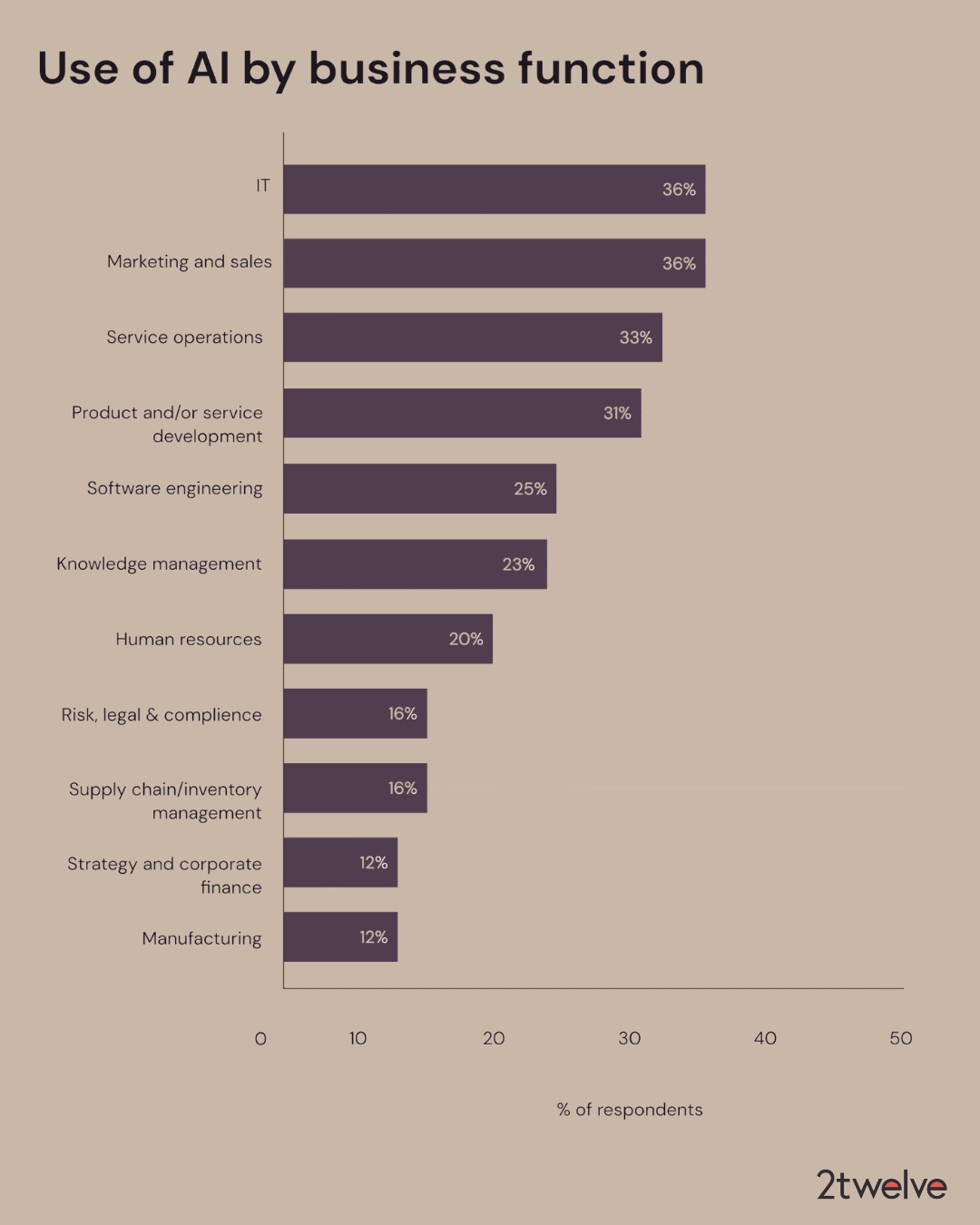
According to Hostinger, the AI adoption rate increased from 55% in 2023 to 78% in late 2024 and early 2025. Over 80% of US companies use AI in at least 2-3 business functions. Below is a graph relaying how much each of the following industries is relying on AI for their business functions:
Source: Hostlinger
According to the statistics above, we can see how there's a 36% adoption of AI in the marketing and sales industry. Alarmingly, it’s right up there with the IT industry where AI is used for vibe coding.
It’s safe to say vibe marketing is here to stay. There’s a high chance it’ll further branch out to more specific marketing strategies and thus change its face in the future but for now, everyone’s trying for a piece of the pie.
Is it the Future of Brand Building?
Unless it’s a blue ocean brand, yes. In this oversaturated market where there’s a brand and a product or a service for just about everything – staying emotionally relevant is the biggest gamechanger. That is exactly where vibe marketing comes in.
Brands going forward will cater to speak to people’s feelings and build or connect with niche tribes that aren’t defined by demographics but by emotional resonance. Since most brands will be challenging already existing brands – including legacy brands, this is the best strategy to implement if they want to beat the markets and come out on top.
Cultural Impact
Several brands are already deploying vibe marketing – much to the oblivious public. But if you let its scalability and efficiency get to your head and lose the human-led connection at the helm – then the cracks start to appear.
People recently lashed out at Coca Cola for using AI in advertisements, but when Heinz or KitKat did it – people loved it. The difference is that Heinz and KitKat campaigns were human-led and monitored for quality checks and accuracies.
Conclusion
In the end, vibe marketing is not a passing fad – it’s a generational shift. Traditional brands will have to adapt to its winds and mercies while emerging brands with modern leaders will be able to leverage it most efficiently. All of this, of course, provided people don’t get too greedy and let AI take over everything.
Remember – machines don’t vibe – humans do. And it’s all because we’re each our own unique character – and if you want to render such a unique character for your brand – hit us up and let’s get talking.