
The Journey of a Brand from Idea to Identity
A Comprehensive Guide to Building a Scalable Brand Identity System
In 1952, the prime minister of India grew concerned that Indian women were spending precious foreign exchange on imported beauty products. This one concern gave birth to a brand that went on to become a legend in India’s beauty market.
But when JRD Tata founded this brand as a subsidiary of Tata Oil Mills, they faced a unique problem. Previously, they decided to name the brand “Lakshmi Beauty Products," a beauty product line made for the Lakshmis, the women of India. However, the brand could not become a crowd favourite immediately. Women in India had already put their trust in French beauty products.
This was when Simone Tata joined “Lakshmi Beauty Products” and changed the name to a word derived from a famous French opera. Coincidentally, the opera was named after the French rendition of the Sanskrit word Lakshmi. The word in question was Lakmé, and thus was born the brand that became synonymous with beauty in India.

What is a Brand Identity

The story of Lakmé is not just a brand’s origin story; it shows how identity is shaped by culture, behaviour, and people. A brand is not an offering; it is primarily an idea. Brand identity helps us communicate that idea visually and verbally.
A scalable brand identity system comprises five key pillars.
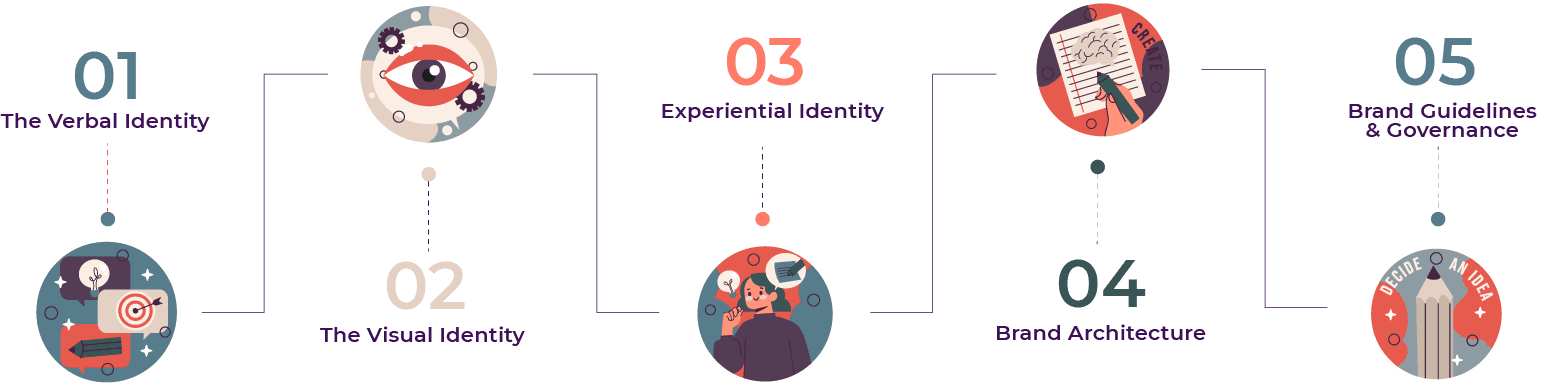
Together, these five pillars build brands that people love and connect with. While designing a brand identity system, a brand must focus on the people. What are the problems? What makes them happy? Where do they invest their time and money, and, most importantly, how do they speak to each other?
Brand identity is a tangible asset for any brand. It allows people to experience the brand holistically through visuals, words, sound, and taste. The primary focus of developing a distinct brand identity is to fuel recognition, amplify differentiation, and make big ideas sound achievable.
Brand identity systems embody abstract ideas like emotion, context, and essence through design, and that is what matters most to people: to see what a brand believes in.
Understanding the ideals your brand is built on and communicating them through clear language and visuals with specific intent is an integral part of your brand strategy. In this blog, we will break it down with actionable strategies and effective frameworks that you can use in your next brand-building exercise.
Let’s Clarify the Strategy First
A strong brand stands out in a highly saturated market. People identify with the brand, trust it, and believe in its superiority. An effective brand strategy helps a brand achieve that. A well-defined brand strategy articulates the ideas upon which the brand is built. Your brand strategy should align with your business strategy and reflect values and culture. It should also define the brand’s target audience and ideal positioning.
Making the Core Stronger
The best brands stand for something that builds their core. Think of Apple; Apple powers innovation, and it stands guard over it. Having a stronger core allows brands to define their positioning in a cluttered market. So, how do you find the ideals you want to stand for as a brand? This is where you can use the brand vision model.
The brand vision model is a multi-dimensional framework that includes brand essence, core elements, and external elements. The brand essence is the succinct idea that the brand wants to stand for.
The core elements comprise supporting ideas, and the external elements are the other ideas that add texture to the brand, such as brand personality, brand voice, etc. This model is tailored to the brand’s context. It is aspirational and can be adapted to different product markets.
Understanding The Positioning
Effective brand positioning allows your brand to tell its story to the right people, in the right language. Positioning helps your brand develop a perception. It answers four primary questions.

Brand positioning requires you to narrow down your brand values, what moves you, what your audience cares about, and why they should care about you. A clear, specific, and intentional positioning fuels growth and helps your target audience engage with your brand.
The Brand Ideals
Brand ideals are the strongest pillars of a functional brand strategy. Brand ideals are defined by your brand vision, the meaning you stand for, commitment, longevity, authenticity, flexibility, values, differentiation, and coherence. The best brands bring intelligence, insight, imagination, and craft together. These ideals help you create a brand impact by influencing perception and changing behaviour. Behaviour drives customers to the bottom line.
So, now that we have clarified the strategy, let’s define your brand identity.
How to Build a Scalable Identity System
Every brand has three primary functions:

A structured brand identity system fuels recognition, amplifies differentiation, and makes big ideas and meanings feel achievable.
The Verbal Identity
Think of Nike; the first thing that comes to mind is the tagline “Just Do It.” This is Nike’s verbal identity. It sets the tone for how its target audience should perceive Nike. However, the name and the tagline are not the only thing that builds your brand’s verbal identity.
The verbal identity system includes three aspects: brand vision, brand personality, naming system, and messaging standards. The verbal identity system defines how your brand sounds to its target audience. Verbal identity is not the same as the tone of voice.
The tone of voice defines how a brand speaks. However, the verbal identity defines a distinguished brand character. Having a defined brand character allows brands to communicate big ideas, take a stand on matters of importance, and stay authentic to their core philosophy.
Another crucial part of the verbal identity system is the brand name. The right brand name depends on context and strategy. An effective brand name is meaningful, memorable, distinctive, highly adaptable, and legally available. A name is an essential brand asset, and a well-chosen one works for your brand 24x7.
And finally, the pièce de résistance of a brand’s verbal identity is the tagline. Taglines are phrases that capture a brand’s personality, values, differentiation, and positioning in fewer words. Going back to the example of Nike, the tagline shows that the brand stands for taking action. They’re not just selling athletic gear or shoes; they are selling aspirations of doing something new, learning a new trick, and ticking off one task from the to-do list, and they communicate it clearly and coherently with just their logo mark and the tagline. Which brings us to the next step of our identity system: the visual identity design.
The Visual Identity
If you look at the story of the brand Lakmé or Nike, you’ll see that the logo plays a huge part in the brand’s appearance.
A small acute accent while writing a word derived from Indian texts, or a mark inspired by the wings of the goddess Nike that looks so similar to a tick mark, defining a completed task. Both logos worked because they made the audience feel something.
Lakmé’s Francophone appearance told the target audience that this brand is as good as French cosmetics, and Nike’s swoosh defines determination, progress, and success in the most simplistic form.
The logo, however, is not the only aspect of the visual identity system. The visual identity includes typefaces, colour palettes, and, of course, imagery and icons that make your brand distinct.
The visual identity is the first touchpoint for your brand; it is how people see you. You have already decided on a name, a tagline, a value proposition, and an offering; now it’s time to decide how your brand should look across various media points.
The first aspect of a visual identity is the colour palette. Research shows that a distinct colour palette increases brand recognition by 80%. Your colour palette should include 2-3 primary colours and 2-3 secondary colours for building hierarchy and variety. The neutrals in your colour palette are for background colours, and the single accent colours are used on CTAs and as highlighters for text.
While building a well-defined visual identity, precision is key. Every inclusion in your colour palette should be defined by values for digital (hex, RGB) and print standards (CMYK, Pantone). A slight mismatch in the digital and print values, and you’ll end up with a billboard that does not match the Instagram post you’ve spent two days working on.
The next aspect of the visual identity system is the typography of your brand. Typography conveys a brand’s personality and the meaning it is striving for. A well-chosen or well-designed typography style can help a brand be immediately recognized in a cluttered ecosystem.
Choosing the right typeface for your brand requires you to understand how typefaces function and how they can differ dramatically from print ads to websites and from packaging to mobile apps. While choosing the typography for your brand, clarity, legibility, and personality are paramount. It should be flexible and easy to use with a wide range of expression.
Designing the visual identity for your brand is like curating for a fine art exhibition. The only goal of this exercise is to make your audience feel something: an emotion, recognition, nostalgia, love, or determination. While these are intangible feelings, the next phase in the brand identity system allows the target audience to feel something tangible.
Experiential Identity
Experiential identity helps a brand to develop a distinct experiential identity through sound, taste, texture, flavour, or smell. Think of Netflix or Apple; the first thing you remember is the “Tudum” of Netflix or the starting sound of the MacBook. These are not random sounds; these are well-thought-out inclusions in the brand identity system that made the brands immortal in people’s minds.
Similarly, the distinguished flavour of KFC chicken and the jingle of McDonald’s go way beyond just the brands and the outlets. They create memories that keep bringing you back to them.
Brand Architecture
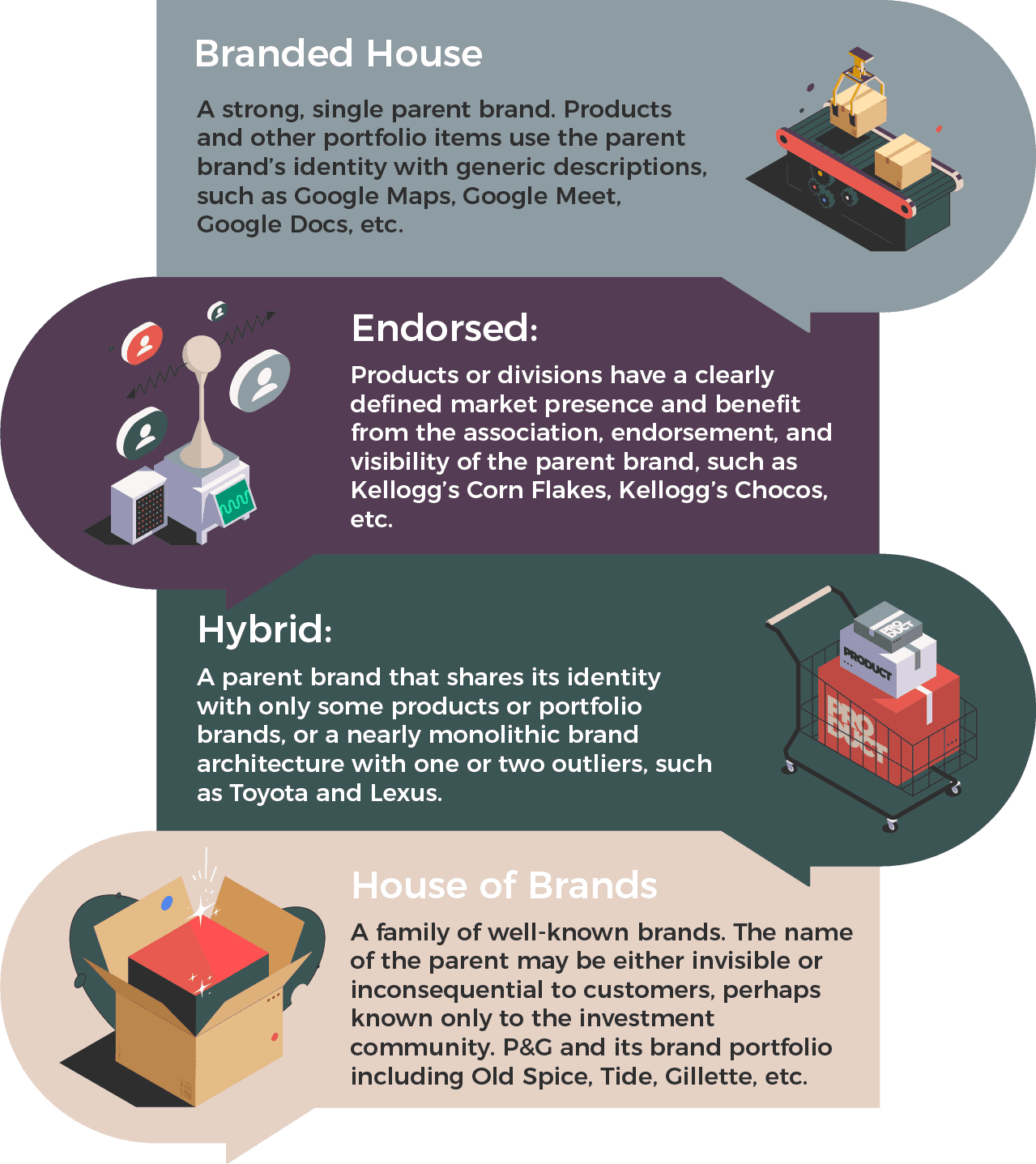
Brand architecture brings structure, logic, and visual and verbal order to diverse brand elements, helping a company communicate its messages more effectively. As companies merge with, acquire, or create new companies and products, branding, marketing, and nomenclature decisions become increasingly complex.
Brand architecture helps a set of brands relate to one another. It defines the relationships between the parent company, the subsidiary companies, products, and services. Defining the brand architecture effectively helps brands clarify what is available to the customers.
Four distinct types of brand architectures clearly define the relationships between the parent brands and subsidiary brands, and between brands and their products and services.
Brand Guidelines and Governance
The last phase of a brand identity system is documenting all your choices with samples in a PDF. This PDF is your brand guidelines. This allows you to visualize how your brand should look in different media spaces.
It also allows you to train your employees in the values of your brand. Your employees are your brand’s biggest ambassadors, and your brand identity should reflect that culture.
Your brand guidelines should also document an evolution protocol and artificial intelligence governance. This ensures your brand stays consistent across media channels and in AI usage.
Summing Up
A well-defined brand identity system is the cornerstone that helps a brand to create a lasting impact. Brand identity systems help brands to communicate their big ideas while being centered on their core values. With the advent of multiple media touchpoints and their dynamic user needs, the importance of having a brand identity system in place is more than ever. Although the brand identity system acts as an anchor for a brand, it is not inanimate; it grows with the brand while carrying the foundational values to its core.