AI in Advertising: Where Is the Future Headed?
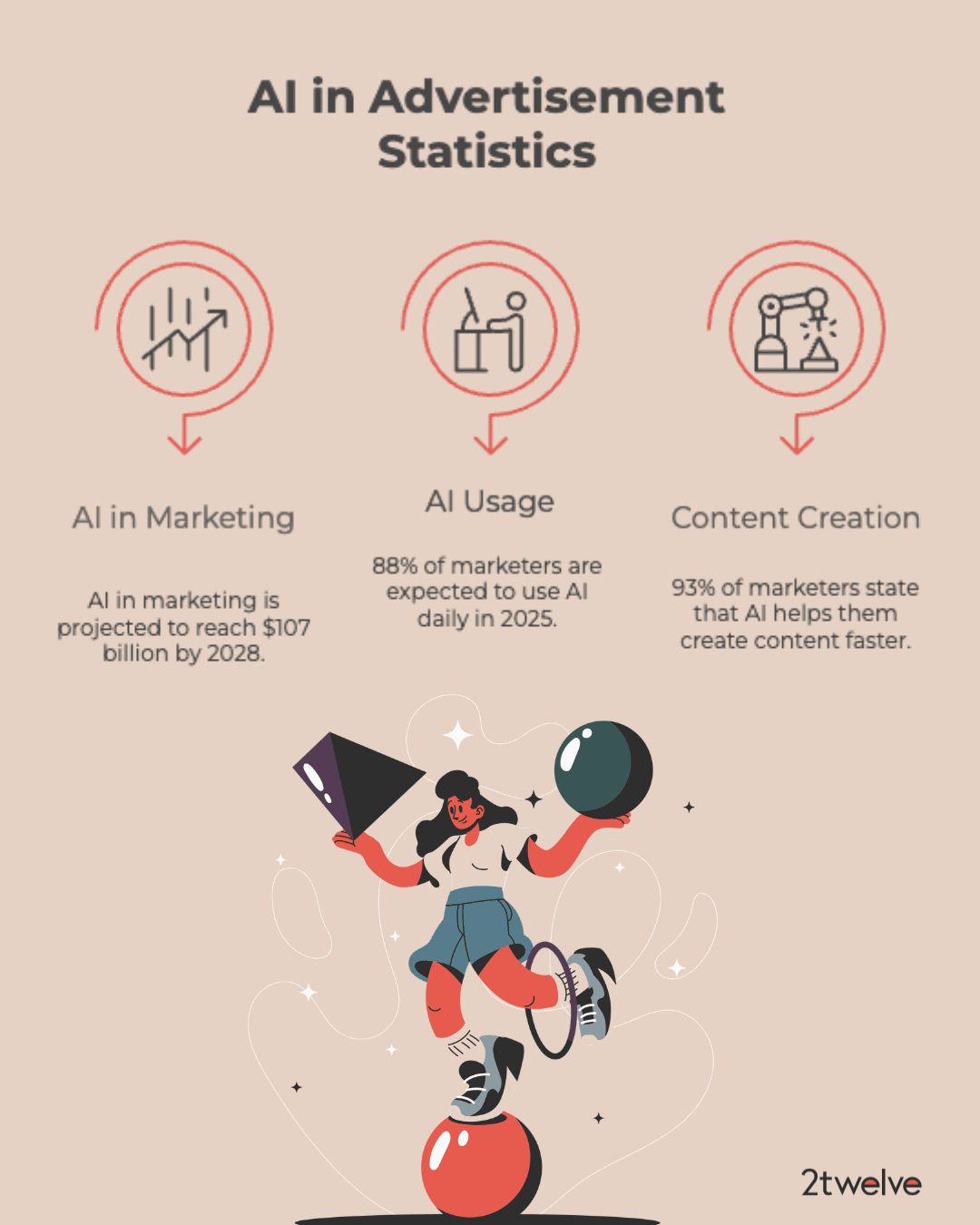
AI has officially entered the room. The debate about whether it belongs in advertising ended about two years ago; the industry has moved on, and the adoption numbers make that clear. What hasn't been resolved, though, is the more interesting question: now that everyone has access to the same tools, what actually separates the brands using AI well from the ones just using it a lot?
That distinction matters more than it might seem. Because AI, for all its genuine power, doesn't come up with a strategy pre-loaded.
Let's give credit where it's due. AI has done something significant for advertising: it has removed the ceiling from execution. Producing ten campaign variants used to require a week and a team. Personalising creative across audience segments at scale was a capability only the best-resourced brands could afford. Testing, optimising, predicting – all of it faster, cheaper, and more precise than anything that came before.
The efficiency gains are real. So is the intelligence. AI's ability to analyse behavioural data and optimise in real time has meaningfully raised the floor for what a competent campaign looks like. Average is now cheaper to produce than ever. Which is exactly where it gets complicated.
The gap no one's talking about
Here's what the adoption statistics don't tell you: widespread use of the same tools, trained on the same data, optimising toward the same engagement signals, tends to produce content that looks and sounds increasingly similar. The feeds are full of it. Competent, well-targeted, thoroughly optimised and oddly indistinguishable from each other. The brands cutting through aren't doing it because their AI is better. They're doing it because their strategy is clearer. They know what they stand for, they know who they're talking to, and they use AI to execute that with precision, not to figure it out.
A strong brief fed into AI produces strong output. A vague one produces content that's fast and forgettable. The tool doesn't fix the thinking. It just moves faster in whatever direction you point it.
Three shifts worth paying attention to
1. Agentic AI is coming
The next wave isn't generative content. It's AI systems that autonomously manage campaigns end-to-end - allocating budget, adjusting targeting, scaling what works, cutting what doesn't, all in real time without a human approving every decision. This is already live at the infrastructure level and will reach mainstream adoption faster than most marketing organisations are built to handle. The strategic question isn't whether to adopt it - it's deciding, deliberately, where human judgment stays in the loop.
2. How brands get discovered is being rewritten
Search behaviour is shifting in ways that will quietly reshape brand strategy over the next few years. Audiences are increasingly turning to AI interfaces to research and recommend and those interfaces don't surface brands from a keyword match. They surface brands with authority, credibility, and a presence in trusted sources. If your brand isn't being cited, it may not be found. That's not an SEO fix. It's a longer-term investment in substance.
3. Cultural intelligence is still a human job
AI works from patterns. It is very good at identifying what has resonated before. It is not equipped to know what a moment means; the cultural subtext, the things an audience feels but hasn't said, the instinct that a particular idea will land or misfire in a particular context. That gap is real, and the brands that respect it will make fewer expensive mistakes than the ones that don't.
So where does that leave us?
AI is one of the most powerful tools the advertising industry has ever had access to. It genuinely changes what's possible at every level - speed, scale, targeting, personalisation, optimisation. None of that is hype, but a powerful tool in the hands of an unclear strategy produces a lot of output, very quickly, going nowhere in particular. The brands winning right now are the ones who understood that early: AI doesn't replace the need for sharp thinking. It raises the stakes for it.
The future of advertising isn't AI-led, it's AI-enabled. Shaped by people who know exactly what they want to say, and use the best available tools to say it better.